

Guests at Panda Restaurant Group’s Panda Express restaurants look forward to a delicious meal, but in addition to the food, they may be delighted by the service they receive. If the organization’s Learning and Development (L&D) team has anything to say about it, guests will be served by a team that delivers such a high level of cuisine and service that they will leave with more than a full belly. They will leave with the impression that they are highly valued and should return.
Learning that develops employees capable of delivering such an experience and doing right by a restaurant company’s guests also provides an essential ingredient needed for profitability. The support Panda’s L&D professionals provided to the organization in 2024-2025 extended all the way from frontline, guest-facing employees to the managers and executives who benefited from a comprehensive leadership development program.
A QUALITY GUEST EXPERIENCE
For a restaurant company, the quality of the food is paramount. To ensure that the star of its services— the food it serves—is consistently at a high level, Panda’s L&D team reimagined its Kitchen Modules, a structured sequence of training within the Store Leadership Training System (SLTS) that teaches all kitchen associates how food is stored, prepared, and served.
Each two- to four-week module now blends eModules, TikTok-style videos, and a new visual recipe book that defines “what good looks like.” Successfully completing each module requires multi-level validation from area coaches and regional directors. Responding to needs assessment findings, for the first time, kitchen roles now have a clearly defined career path.
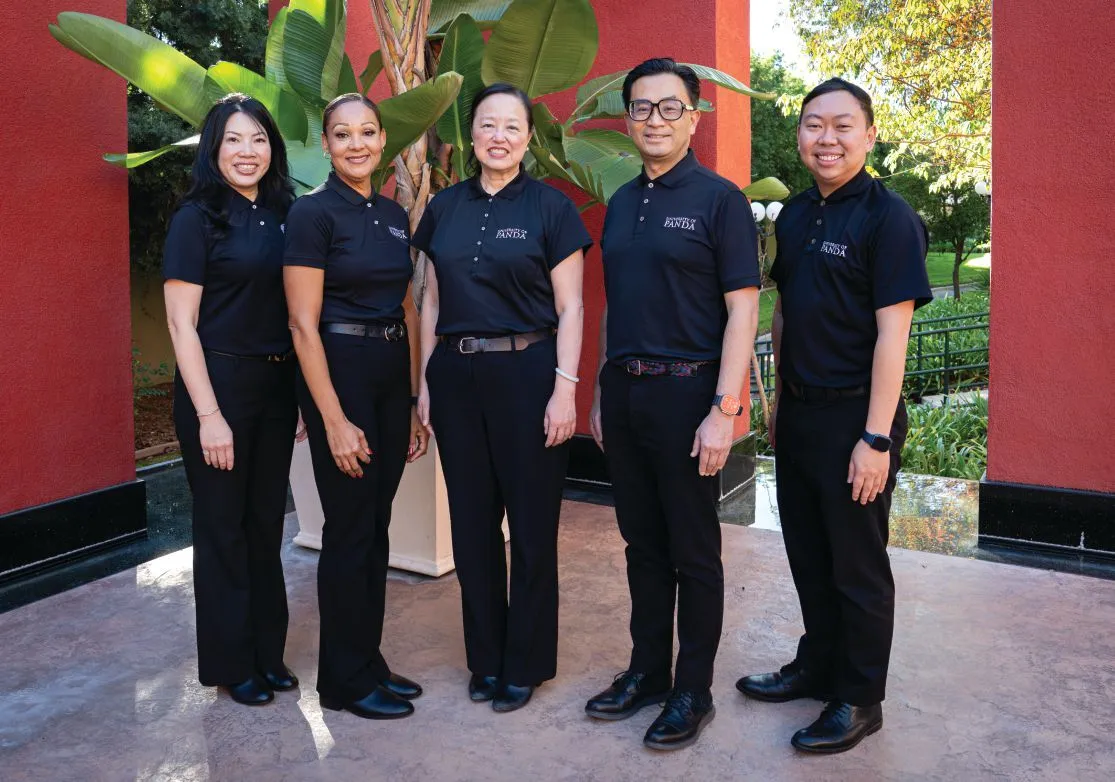
“The revamp set out to elevate food quality as a brand standard,” says Executive Director of Learning and Development Dora Lee. Supporting Panda’s 2025 strategic priority—Delivering Exceptional Guest Experiences—this initiative was designed to ensure every item on the menu reflects recipe accuracy, proper execution, and exceptional taste across all locations, helping achieve the following 2025 goals:
- A 2 percentage point increase in Taste of Food score and 2.5 percentage point increase in guests’ Overall Satisfaction (OSAT) score, as measured by the Guest Experience Monitor receipt survey
- A 2 percentage point increase in same-store sales (SSS%) and same-store transactions (SST%) To design the revamp, University of Panda co-conducted with senior Operations leaders a comprehensive three-month needs analysis, assessing food quality during store visits and analyzing guest satisfaction and food quality scores. This revealed a need for more consistent back-of-house training alongside engagement and retention issues stemming from poor performance reviews and lack of standards for promotion. “These findings led University of Panda to not only change how content is created and delivered but also concretely define roles, performance standards, and career paths for kitchen help, cooks, and chefs,” Lee explains.
DEVELOP MORE LEADERS FASTER
Amid industry turnover rates exceeding 80 percent, Panda’s business model still depends on aggressive annual expansion. Each new restaurant requires one general manager (GM), supported by training leaders (TLs) and area coaches of Operations (ACOs), all ready to deliver people, guest, and financial (PGF) results, Lee says. University of Panda’s integrated leadership pipeline strategy is anchored in two flagship programs designed to support ambitious 2025 restaurant opening and leadership goals regarding vacancies and span of control.
The Fast-Track Leadership Development Initiative, created and executed in close partnership with Operations, accelerates development of high-potential TLs and ACOs through: collaborative identification of high-potential talent; tailored pre-course prep sessions; a curriculum focused on the four Panda Competency Model competencies most critical to restaurant leaders’ success (courage, cultivates innovation, drives results, and situational adaptability); one-on-one coaching and mentoring; and auto-enrollment in successive leadership courses.
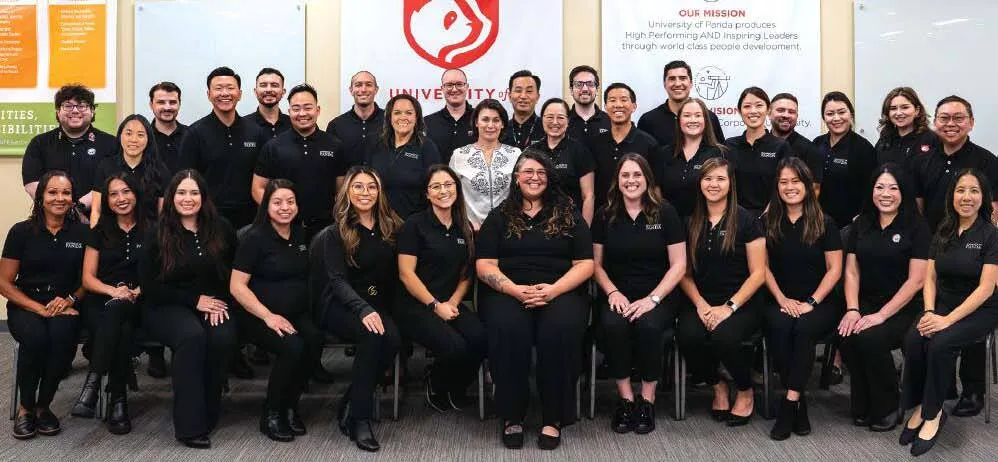
Inspired by Fast-Track’s success, the Store Manager Development Program (SMDP) is designed to bolster Panda’s GM pipeline. The program features evaluation sessions to identify leadership and competency gaps; mock final exams to identify knowledge gaps; personalized development plans to close the gaps; and individual coaching and tutoring.
This multi-layered approach has produced measurable business impact by expanding leadership capacity, accelerating promotion readiness, and improving operational results as follows (all results are through June 2025):
Fast-Track: Panda promoted 35 training leaders and 24 area coaches of Operations; both were on track to fill the total target vacancies by year-end. Time to promotion readiness was reduced by 75 percent, from 9 to 2.25 months. Compared to the standard path, Fast-Track has promoted nearly double the training leaders and ACOs.
Store Manager Development Program: 236 store managers were promoted, directly fueling the leadership pipeline for new restaurants. Passing rates also improved from 77 percent to 90 percent within one year.
Key Performance Indicator (KPI) Impact: “Panda’s leadership development ecosystem is not only producing ready-now leaders but also sustaining growth with measurable returns,” Lee reports. “Panda has opened nearly 100 new restaurants. In addition, management turnover dropped below the 30.5 percent top-quartile industry benchmark reported by Black Box Intelligence.”
GEN AI INCREASES EFFICIENCY
Keeping up with the latest in artificial intelligence (AI) innovation, Panda is incorporating generative AI across its instructional design process. “We’ve embedded generative AI across our ADDIE instructional design process to compress timelines, improve precision, and let designers focus on quality and impact,” Lee says. She shares the key ways the organization is doing this and the resulting time savings:
1. Analysis—from weeks to hours
Before: It took a week after conducting focus groups to synthesize surveys, interview notes, and KPIs to identify themes and draft Bloom-aligned outcomes.
With AI: Rapid text/data synthesis produces themes and outcomes within hours. Time saved per program: four to five days.
2. Design—from month-long research to days
Before: Designing training to support learning outcomes required a month to curate sources, benchmark best practices, and map strategies.
With AI: Relevant, evidence-based resources are quickly curated, with outlines drafted, and methods proposed in three to five days, freeing the team to focus on creative enhancements. Time saved per program: three to four weeks.
3. Development—from weeks to a day
Before: The team spent weeks writing facilitator scripts, learner guides, and assessments—each with multiple edit cycles.
With AI: High-quality lesson scripts, polished notes, and item banks are quickly drafted, enabling developers to finalize in one day. Time saved per program: one to two-plus weeks.
4. Implementation—from logistical trial and error to organized execution
Before: Manual creation/refinement of facilitator guides, timings, and logistics checklists.
With AI: Complete guides, materials checklists, and timing plans are created in the same day. Time saved per program: several days, with fewer iterations.
5. Evaluation—from days to minutes
Before: Developing post-training exams and surveys took days, followed by manual review to identify and analyze common themes in responses.
With AI: Writes valid questions in minutes, quickly analyzing results for patterns. Time saved: several days per cohort.
Overall impact: from two to three months to one
End-to-end development time is down 33 percent to 66 percent per program, enabling faster response to business needs. “Teams spend less time hunting for content and formatting deliverables—and more time synthesizing insights, aligning to strategy, piloting improvements, and elevating learner experience— making launches quicker, sharper, and measurably more effective,” Lee says.
RAISING THE BAR IN 2026
In addition to expanding its use of generative AI, Panda is looking at more ways to optimize technology to enhance the development of its people and the delivery of an exceptional guest experience. Lee shares a few ways the organization plans to do this:
- Mobile learning: University of Panda Online, Panda’s learning management system, is extending learning into the flow of work through WorkJam, a digital workplace app tailored for frontline associates. Accessible via mobile phone or tablet, the platform delivers thousands of University of Panda courses, videos, articles, and books.
- Augmented and virtual reality (AR/VR): “University of Panda is researching and piloting AR/VR training to prepare managers for high-stakes scenarios,” says Lee. One example under development is a robbery simulation where managers practice using the 4 Cs— calm, collaborate, communicate, and comply—while interacting with a virtual robber. Learners practice speaking directly to the robber and making decisions from a multiple-choice list, with each choice leading to a different branch in the robbery experience. University of Panda also is exploring AR/VR applications for cooking techniques and guest service training.
- Training gamification: The company is designing a gamification framework that aligns challenges, levels, and rewards to specific learning objectives, and plans to pilot at least one eLearning course that incorporates these elements in a meaningful way, Lee says “We are evaluating learning platforms and tools that support elements such as digital badges, points, and leaderboards,” Lee says, “with the goal of motivating participation while keeping learning practical and relevant to day-to-day work.”