

In an era increasingly shaped by artificial intelligence, machine learning, and data-driven automation, one truth is becoming unmistakably clear: human judgment is not being replaced — it’s becoming more critical than ever. The 2025 State of Tech Talent Report – Truth vs. Vibe: The Not So Disruptive Workforce Impact of AI offers a compelling narrative of transformation in technical roles, but its data also gestures at a deeper undercurrent: the cognitive edge provided by human experience, intuition, and ethical discernment remains irreplaceable in navigating modern technology’s most complex challenges.
While AI has dramatically improved productivity in areas like code generation, infrastructure monitoring, and data analysis, the notion that data alone can drive effective decision-making is proving incomplete. AI systems depend on historical data, predefined parameters, and probabilistic models, but real-world problem-solving often requires navigating ambiguity, novel edge cases, and competing priorities — tasks where human insight is indispensable.
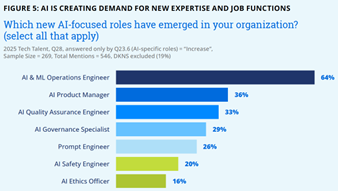
This reality is illustrated throughout the report. For example, while 94% of organizations expect AI to deliver significant value in core functions such as software development and customer support, a majority also report reshaped technical workflows and job responsibilities. Developers, rather than being automated away, are now tasked with reviewing and validating AI-generated code — a task that requires discretion, contextual understanding, and risk mitigation skills. Similarly, the emergence of roles like AI Ethics Officer, AI Governance Specialist, and Prompt Engineer points to the growing need for professionals who can interpret AI behavior, manage unintended consequences, and uphold responsible development practices.
The Importance of Human/AI Synergy
These developments reaffirm that, even in an AI-driven environment, what’s in people’s heads — their accumulated experience, ethical frameworks, and strategic reasoning — remains as vital as the datasets feeding machine models. Indeed, AI’s most effective applications occur when human and machine intelligence are combined. AI excels at pattern recognition and repetitive execution; humans bring narrative understanding, emotional intelligence, and moral reasoning. This synergy is particularly important in high-stakes contexts such as cybersecurity, regulatory compliance, and healthcare, where automated decisions must be guided or overridden by expert judgment.
Moreover, technical decision-making increasingly intersects with broader organizational strategy. As the report highlights, organizations are no longer looking solely for coders or data scientists; they need professionals who can interpret complex systems, evaluate competing trade-offs, and communicate implications to non-technical stakeholders. These hybrid capabilities — often described as “T-shaped” or “Pi-shaped” skills — are rooted in judgment. For instance, a machine learning engineer must not only build performant models but also assess data bias, align with business goals, and anticipate social impact. These decisions can’t be offloaded to algorithms.
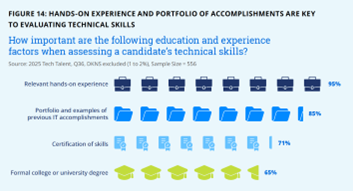
The implications for training and talent development are profound. Upskilling programs that focus solely on technical capabilities — programming languages, cloud platforms, AI tools — are insufficient without nurturing higher-order thinking. Organizations must embed ethical reasoning, decision-making under uncertainty, and systems thinking into workforce development. Encouragingly, the report shows that companies are starting to value practical work and portfolio evidence (85%) over traditional academic degrees (65%). This shift aligns with the recognition that judgmentcan’t be conferred by credentials alone — it’s demonstrated in real-world decisions, collaborative projects, and the ability to adapt.
Furthermore, judgment becomes paramount as AI systems scale across disciplines. In edge cases — such as hallucinations in generative AI, misaligned incentives in recommendation engines, or adversarial attacks in security — it is human oversight that identifies anomalies and applies corrections. Judgment also governs the allocation of resources: Should a company invest in refining a model, improving the dataset, or restructuring the user interface? Only a holistic, context-sensitive decision-maker can answer that.
The growing influence of AI in the workplace does not diminish the role of human judgment — it elevates it. Far from making humans obsolete, AI has made them more strategically essential. The organizations that thrive in the AI era will be those that empower their teams not only with technical tools but with the freedom and training to exercise discernment, ask difficult questions, and steer technology with intention. Judgment, in this sense, is not a relic of the pre-AI world; it’s the operating system of the future.
______________________
The 2025 State of Tech Talent Report – Truth vs. Vibe: The Not So Disruptive Workforce Impact of AI is available for download for free.