

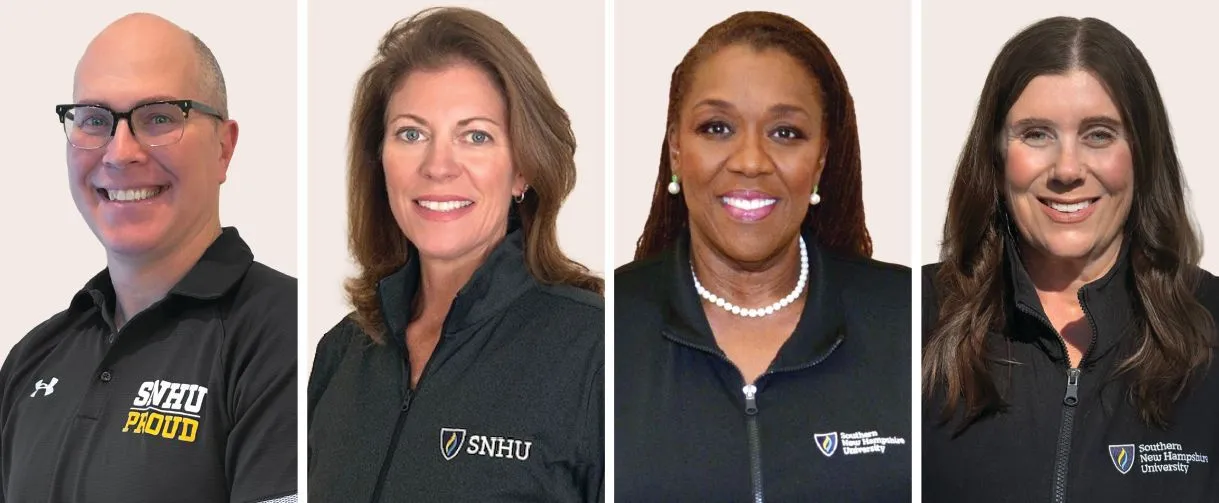
Southern New Hampshire University (SNHU) is in a league of its own when it comes to employee training and development. Backed by a strong lineup of training programs aligned with business goals, newly centralized learning strategies, and a deep L&D bench bolstered by AI and data analytics, SNHU won the top spot in the Training MVP Awards rankings this year.
“The need for clear linkage between business objectives, learning objectives, and employee learning experiences as detailed in the Training MVP Awards application process has leveled up our approach and increased the ROI the university receives through employee learning,” says SNHU Vice President of Talent Development Philip Nazzaro. “And the focus on innovation within the Training MVP process has been a great incentive for us to continue to push our thinking about what is possible in the learning field.”
LEARNING CENTRAL
The evolution of SNHU’s federated learning and governance model in fiscal year 2025 brought several formerly separate Learning teams together into a single central unit while reaffirming the importance of specific elements of the Learning function structurally being embedded within the business, Nazzaro says.
In a similar vein, SNHU centralized all learning and development strategies at the university level. “Efforts such as our Skills Based Organization work, Vision of a Leader development and learning build, our reimagining Performance Excellence, and our organization-wide EDI Foundations Learning Experience all became part of the university’s strategic portfolio and not simply Talent Development or People Team efforts,” Nazzaro explains. “This allowed the work to draw from people who possessed the skills needed for the learning efforts but not assigned to a Learning team.”
This is true for senior leaders at SNHU, as well, as they are committed to the power of learning and are active and vocal participants in and creators and facilitators of learning experiences, Nazzaro says. For example, Chief People Officer Heather Baram, along with Chief Diversity Officer Jada Hebra and Chief Operating Officer Danielle Stanton, were active sponsors of the EDI Foundations Learning Experience that SNHU launched in FY’25, led by Vice President of People Experience and Inclusion Shanita Williams. They engaged in sessions that helped shape the initial direction of the learning, as well as the content and approach. Other senior leaders such as Chief Experience Officer Sue Nathan and Vice President of Advising Scott Barker shared their personal experiences in the learning through organization-wide videos.
SNHU’s culture change initiative—which focuses on moving from an expert culture to a learning culture— asked senior leaders, including the C-suite, to be active sponsors and change champions of the organization’s new Core Values and Core Skills. Nazzaro says these senior leaders facilitated executive conversations with their teams, leveraged centrally created toolkits, participated in learning videos, and reinforced new values and skills in communications and SNHU’s performance review process.
ELEVATE 2.0
To meet the challenge of increasing complexity and volume of learning needs across the organization, SNHU elevated its hallmark Elevate individual contributor program (which has been in place since 2021) to a 2.0 version over the course of late FY’24 and early FY’25. “Elevate 2.0 builds on our original Elevate program’s tailored development for individual contributors, aligning learning with our new university Core Skills, promoting career growth, and enabling stronger leadership at all levels,” says Associate Vice President of Talent Development Kerri Kellan.
Participants select from nine different and customizable Core Skills and Core Values Learning Journeys and engage in reflective practices and coaching from their leader. Leaders support development focus area selection and provide validation of learning transfer into the workplace. Participants select from tailored self-paced courses and engage in a required instructor-led training for each Core Skill they choose. Leaders of Elevate participants are provided with support throughout the learning to help participants with the application of new skills. These include toolkits and job aids to help them coach for skill application and validation of skill attainment in their direct reports.
Director of Personal and Professional Development James Marcille notes that Elevate is deeply interrelated to the progression paths for some of SNHU’s largest employee populations, such as the Student Experience Team of 3,052 people. “Their progression is dependent upon completion of an Elevate Meta Badge, which requires completion of three Core Skill-aligned badges,” he explains. “With hundreds of people at various stages of badge and meta-badge attainment in the old Elevate, we worked closely with leaders across business divisions, HR, and compensation to ensure people did not lose out on the opportunity for job progression as we time-phased the switch to Elevate 2.0. We also offered the full old program as we built the new version.”
In FY’25, Nazzaro says, SNHU retained 97.24 percent of Elevate participants and 90 percent of all individual contributors. In addition, 88.34 percent of Elevate participants had positive behavioral changes in the application of learning in their work attributed to their participation in the program.
EVERYDAY RESILIENCE
SNHU’s focus on learning and business impact has led the university to invest heavily in its learning analytics function. “Demonstration of impact and return on investment ensures that our learning resources and the time people devote to learning are spent on experiences that will have lasting positive impact for our people, for SNHU as an organization, and ultimately the students we serve,” Nazzaro explains. “This last year, our Everyday Resilience for Leaders Learning was a shining example of this positive impact of learning.”
In today’s rapidly shifting environment—where demographic trends, regulatory shifts, and disruptive external pressures converge—resilience is no longer a desirable trait; it is a strategic necessity, says Senior Director of Talent Development Brian Sollenberger. “Leaders must navigate constant change while safeguarding both their own well-being and the stability of their teams.”
To meet this imperative, SNHU collaborated with its vendor partner, Pause At Work, to create a program that translated breakthroughs in neuroscience into immediate, practical leadership applications, thus creating a dynamic “research-to-practice pipeline.” “This innovative design empowered leaders not only to recover quickly from setbacks but also to anticipate and adapt skillfully to change,” Sollenberger says.
By embedding evidence-based strategies directly into the learning journey, leaders gained actionable tools to:
- Lead with greater presence, mindfulness, and confidence, even in high-pressure moments
- Navigate and diffuse complex interpersonal dynamics with greater ease
- Cultivate authentic, trust-centered relationships across their teams
SNHU offered this training as a series of four virtual instructor-led sessions. Kirkpatrick Level 2 evaluations came in at an average of 89.9 percent against all learning objectives. Behavioral outcomes were assessed using a matched pre-post sample. Associate Director of Learning Impact Jasmin Williams cites statistically significant results that demonstrated positive improvements across the objectives pertaining to stress relief (+22.7 percent), mindful awareness (+20.8 percent), emotional intelligence (+17.8 percent), and resiliency (+6.4 percent).
“Two critical business goals of our leadership development learnings are employee engagement and retention,” she says. “FY’25 data on this learning showed participant attrition rates 1 percent lower than those of non-participants, translating into a 35.51 percent positive return on investment due to avoided turnover costs.”
DEVELOPING “HUMAN” SKILLS
SNHU invests in the full gamut of learning types, including compliance, student support, technical skills, coaching, and leadership and human skill development. Nazzaro says the largest investments SNHU makes in terms of learning are in human skill development, leadership development, and front-line staff skill development within its Student Experience Teams. “This triad of learning maximizes SNHU’s investment in the areas that will yield the biggest return,” he says.
Human skills span every team and division at SNHU. “As AI continues to advance and digital technologies become more like digital coworkers, human skills become ever more essential to the success of SNHU in achieving our mission and serving our students,” Nazzaro says. In addition to Elevate, SNHU’s suite of career growth supports—including Career Navigator, career development-focused learning experiences, and oneon- one support with internal career coaches—integrate human skills into the learning opportunities offered as essential components of charting and growing in a career. The university also has access to synchronous and asynchronous learnings focused on human skills, such as Emotional Intelligence: Foundations to Connections and Everyday Influence: Clarity to Impact micro-credentials.
“Closely aligned to our human skills learning and equally as integrated with our Core Values and Core Skills, SNHU’s Leadership learning is a critical investment in advancing our mission and supporting our employees and students,” Nazzaro says. “Leadership learning experiences such as the Peak Leadership Lifecycle program and our Leadership Development Series build the capabilities of our leaders to coach, develop, and lead our people and teams. Leaders ultimately become facilitators of the development and application of human skills within the flow of work.”
Senior Director of Learning Development Lauren Cortese says SNHU also places a sizable amount of its learning resources in the support and development of its frontline staff. “Ensuring that Student Experience team members have the best possible technical training in their roles is an essential component of our success,” she notes. “Programs such as the Student Experience onboarding, University Catalog training, and Student Advising’s Peer Development Program led by Jule Sughrue and Sheila Urban ensure that the people who have the deepest relationships with our learners are prepared to provide best-in-class service and support.”
AI’S INCREASING ROLE
AI continues to take on a larger percentage of the learning resources at SNHU. “AI supports us in refining learning objectives, brainstorming engaging activities, voiceovers, and drafting assessment scenarios that mirror real-world challenges,” Director of Learning Design Rebecca Levielle says. “This allows us to quickly explore creative design options while ensuring strong alignment with desired performance outcomes.”
In addition to development support, SNHU is beginning to explore how AI can personalize the learner experience in human skills training, specifically through customizable chatbots that reinforce key concepts, answer questions, and support retention and transfer after training. Other technical skills teams across the organization use AI to draft content and accelerate early design phases.
While SNHU provides an AI Literacy Foundations course required for all team members, Associate Vice President of Strategic Foresight Marcy Vadurro says one of the most exciting applications of AI is within the university’s eight-week Generative AI: Concept to Innovation learning experience. “This professional skills course helps learners become stronger users of AI to become more efficient and productive in their work and personal lives,” she says.
This learning experience takes participants from prompt engineering through AI graphics and video creation and also covers the ethical implications of the technology. Within this experience, AI serves as a coach and tutor to the participants. Learners engage in assessments facilitated though dialogue with an AI colleague. SNHU has seen proficiency ratings from pre- to post-course increase by more than 61 percent to 91.54 percent proficiency at applying AI skills.
ON DECK FOR 2026
In 2026, SNHU plans to continue and accelerate its dual-path approach to AI. “We want to ensure team members across the organization possess the knowledge and skills to leverage AI in their work while leaning into how AI can continue to transform our learning supports to meet learner needs faster and with greater personalization,” Nazzaro says.
As technology advances to help make personalized learning more possible, the role of L&D is changing, Nazzaro notes. “We aren’t just designers and facilitators anymore. We must be curators and connectors to facilitate people building knowledge, skills, and relationships to advance our collective work. We have an obligation to have a measurable positive business impact but also to be trusted partners to leaders and individual contributors in their personal growth. As a Learning team, organization, and professionals, we have to continue to grow and evolve to help support growth in a world where learning likely will look very different in the next 18 to 24 months.”