

The last year was rich in insight for the learning and development (L&D) profession. Across multiple Training Pulse surveys in 2025, and now reinforced by early indicators for 2026, a clear and consistent picture is emerging.
The message is not that L&D must change direction again. It is that the direction is clearer and expectations are higher. Indeed, for the last two years, the L&D industry has talked endlessly about transformation. 2026 will reveal which organizations achieved it.
WHAT 2025 CLARIFIED
2025 Training Pulse research surfaced three important realities that resonated strongly across the global L&D community:
1. Emotional intelligence remains the most difficult soft skill to develop, despite being central to leadership effectiveness.
2. Artificial intelligence (AI) is now firmly part of the learning landscape, though still accompanied by understandable questions around ethics, governance, and value.
3. Leadership development continues to be essential, but traditional approaches are misaligned with the complexity today’s leaders face. While these findings point to a need for deeper integration between technology and humanity, data and judgment, learning design and lived experience, many in the L&D industry simply responded with repackaged workshops and shiny AI demos with no operating model. That is activity, not progress.
EARLY 2026 POLL RESULTS
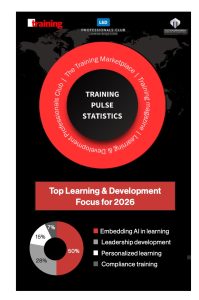
A current poll of L&D professionals (274 responses to date) provides a useful lens on the top priorities they are focusing on in 2026:
• Embedding AI in learning: 50%
• Leadership development: 28%
• Personalized learning: 15%
• Compliance training: 7%
Rather than viewing these as competing priorities, it is more helpful to see them as layers of the same conversation. AI is not replacing leadership development, and personalization and compliance are still important. But expectations have shifted.
The prominence of AI in learning reflects organizations’ growing desire for:
• Greater relevance
• Faster capability development
• Clearer evidence of impact
Most organizations see AI as a means of improving access, insight, and scale, rather than as a substitute for human expertise. Crucially, the 2025 findings reminded us that emotional intelligence, cultural awareness, and ethical judgment remain areas where human learning and reflection are irreplaceable. The opportunity for 2026 lies in combining these strengths, not choosing between them.
In 2026, personalized learning increasingly will be viewed as a baseline capability enabled by AI, informed by data, and shaped by learner needs rather than a standalone strategic objective.
LEADERSHIP DEVELOPMENT EVOLVING
Leadership development remains a central L&D concern, but its form is changing. Leadership development programs must teach leaders how to:
• Exercise their judgment to determine when AI gives conflicting or incorrect answers
• Utilize their emotional intelligence when automation removes human touch
• Be accountable when algorithms fail
A GLOBAL PERSPECTIVE
These themes are consistent across the L&D Professionals Club, a global community of 480,000-plus members. Through the worldwide reach of The Training Marketplace, similar patterns are visible:
• Buyers are prioritizing outcomes over courses.
• There is growing interest in embedded AI-enabled solutions that are human centered.
• The emphasis is on relevance, quality, and impact.
WHAT THIS MEANS FOR 2026
The year ahead is less about reinvention and more about intentional progress. If you lead L&D, design programs, or sell training:
1.Stop selling learning. Start selling capability.
2.Stop separating AI from leadership and embed it where it genuinely adds value.
3.Stop mistaking participation for progress.
4.Embed emotional intelligence through practice and feedback where work happens.
5.Measure learning by what changes, not who completes what.
2026 offers an opportunity for the L&D profession to strengthen its role as a strategic partner, combining technological capability with deep human understanding. The L&D organizations and solution providers that succeed—that transform—will be those that consistently turn insight into impact.