

Chilled air needed to maintain sophisticated computer equipment circulated the room dominated by several large monitors for emerging tech demos at the Central Florida Tech Grove location in Orlando that hosted Training’s recent Learning Leaders Summit, sponsored by GP Strategies, VRAI, and WellSaid. The agenda included a spin through some of the latest training tech innovations by the University of Central Florida’s Institute for Simulation and Training’s David Metcalf; a look at how Amazon Air is using artificial intelligence (AI) to enhance onboarding; and details on how Accenture trained 500,000 staffers on AI.
Interestingly, in the midst of all that high tech, a decidedly low-tech (for today) image captured most attendees’ attention: the Daimler Motorized Carriage first sold in 1892.
Accenture Learning Innovation and Design professional Ben Dyer showed that image to remind the nearly 100 summit attendees that we need to move beyond “horse-drawn thinking.” “Earlier rival models converted existing horse carriages by adding engines to them, but this model was designed to be an automobile first. So why does it look so much like a horse carriage to us? Because that’s how people thought about passenger travel in 1892,” he explained. “They’d created a technology that was about to change the pace of travel, redefine the layout of cities, power every future war, and invent the teenager. Of course, their thinking about motorized carriages didn’t envision any of those possibilities. It was horse-drawn thinking. We’re in much the same situation now. So how are you thinking about the future AI is making possible? What assumptions do you need to revisit, and what horizons will open up when you reimagine them?”
Dyer’s colleague, AI Innovation Lead Yulia Barnakova, explained that Accenture created some self-paced modules and taught staffers how to build an AI agent themselves to help them improve their productivity and workflow. “To do this at scale, developing an agentic mindset is critical,” Barnakova noted. “Helping employees upskill into their new roles starts with mapping out processes and figuring out how roles change with AI enhancement.”
ONBOARDING AT AMAZON AIR
Amazon Air is using AI to enhance its onboarding program. “We ask new hires about their learning preferences and personality traits and create a Learning & Personality Profile (LPP),” explained Andrew Cooper, Operations manager, NCC University, Amazon Air. “We run those through AI and ask it, ‘What are the synergies, challenges, and strategies we should take to train these new hires?’ We do the same with their manager. We also spend several hours talking about AI foundations and company guidelines. Then we follow up with sessions on prompt generation and custom-built tools to use in their role.”
With regard to AI, Cooper stressed, “the human element is the most important and the hardest part. We are not replacing human connection with AI but enhancing it.”
Cooper also emphasized the importance of belonging, noting that it is not a nice to have; it’s a must-have. “You need to ask: Are you creating belonging cues? Are you creating a safe, inclusive environment for your employees?”
SOLVING THE DELOITTE “DILEMMA”
Deloitte found a way to help ensure a safe and ethical culture by reimagining compliance training for its 470,000 employees. It followed in Microsoft’s footsteps by transforming its ethics learning into a TV show-like learning that incorporates relevant ethics dilemmas, compelling storytelling and engaging characters (played by hired actors), iterative development, leadership involvement, feedback and evaluation, and lessons learned debriefs. Ethics officers brainstorm the topics and do the debrief episodes.
The first episode, “Dilemma,” of season 1 launched in fall 2024. It drew 100,000 views, drove 98 percent improvement in post-course evaluations, and won outside awards. “Employees had watch parties; some offices had popcorn machines, while others rented out a movie theater,” related Deloitte Global Ethics Manager Kaia Samson. “There were whole Reddit threads about the episodes.”
THE SUSTAINABILITY CHALLENGE
Like compliance training, it can be difficult to engage employees in sustainability training, according to Antonio Vizcaya Abdo, professor of Corporate Sustainability at Universidad Nacional Autónoma de México. “Employees are being asked to meet sustainability goals they were not trained to deliver. From content to habits and framework, organizations must prepare their workforces to perform evolving roles.”
He pointed to several key best practices that can help, including connecting sustainability to personal motivation, business strategy, and performance; providing clear guidance on how to apply sustainability; and allowing learners to practice applying sustainability and reinforce it through daily work.
THE POWER OF LEARNING ROUNDS
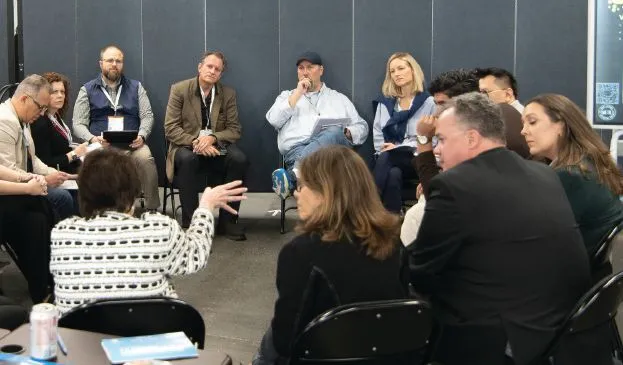
On the topic of engagement, many attendees highlighted the Learning Rounds that were facilitated in the middle of the summit by Karie Willyerd, head of Strategic Engagement, GP Strategies, and Marga Biller, senior project director, Learning Innovation Lab, Harvard University. For these Learning Rounds, five companies provided challenges. Attendees were asked to join one of five learning circles and take on each challenge as if it were their own, brainstorming possible solutions.
As one attendee noted, “Learning Rounds are powerful to fuel human connection in bringing people together to share a solution.”