


In April 1961, President John F. Kennedy authorized an invasion of Cuba that became one of the greatest foreign policy disasters in American history. The Bay of Pigs wasn’t a failure of intelligence or courage. It was a failure of decision-making. Kennedy’s inner circle had fallen into groupthink, where no one dared challenge the prevailing opinion.
Eighteen months later, the Cuban Missile Crisis arrived—a moment where the wrong decision could trigger nuclear war. Kennedy had learned his lesson. He didn’t just make better decisions. He redesigned how decisions got made.
He created competing teams forced to argue opposing positions. Then he made them switch sides. The hawks had to argue for diplomacy, the doves for military action. He brought in outsiders specifically tasked to find weaknesses in every recommendation. “Show me what we’re missing,” Kennedy told them.
The result: a measured response that bought time for diplomacy and avoided catastrophe.
Kennedy’s insight applies directly to every organization struggling with decision quality: Bad decisions usually come from bad decision-making processes, not bad people.
Why Smart Teams Make Poor Decisions
If you have a brain, you have bias. Daniel Kahneman’s research demonstrates that even brilliant people fall prey to predictable cognitive traps under pressure: confirmation bias (seeking information that supports existing assumptions), anchoring bias (over-relying on the first information received), and groupthink (conformity pressure that eliminates dissenting views).
These aren’t character flaws. They are predictable neuroscience.
And here’s the uncomfortable truth: the smarter your team, the more vulnerable you may be. Homogeneous teams of high performers often make worse decisions than diverse teams of moderate performers because similar biases reinforce rather than correct each other.
Most organizations try to solve this with better people or more information. Neither works. What works is what Kennedy discovered: systematic decision frameworks that protect against predictable cognitive failures.
The Binary Trap
Watch any leadership team under pressure and you’ll see the same pattern: Decisions collapse into binary choices. Should we expand or consolidate? Hire or freeze? Launch now or delay?
This is what the Heath Brothers call “narrow framing”—the most common decision-making error. When teams frame decisions as either/or, they’ve already eliminated most of their best options before the conversation starts.
The 5C Decision Framework breaks this pattern by forcing teams through a structured process that expands thinking before narrowing to action.
The 5C Framework
The framework consists of five sequential stages. The power isn’t in any single step. It’s in the discipline of the sequence. Most decision failures happen because teams skip straight to “Choose” without establishing Context, achieving Clarity, or generating real Choices.
C1: Context—What’s really happening here?
Before jumping to solutions, map the full situation:
Stakeholder Analysis: Who has different definitions of “success”? Different risk tolerances?
Real Constraints: What’s limiting us versus assumed limitations?
Decision Type: Is this reversible or irreversible? Use the Cynefin framework (see sidebar below) to classify the problem type—this determines whether you need best practice, expert analysis, experimentation, or immediate action.
Time Horizon: What’s the actual deadline versus artificial urgency?
Why it matters: When stakes are high, teams either tunnel-vision on immediate problems or get overwhelmed by everything that could matter. Context forces disciplined thinking about what does matter. Research by decision context expert Robyn Dawes shows that teams spending time on systematic context analysis solve the right problem far more often than teams jumping immediately to solutions.
The Cynefin Framework
The Cynefin framework, developed by Dave Snowden at IBM in 1999, helps leaders match their decision approach to the type of problem they’re facing. It identifies four domains:
- Clear: Cause and effect are obvious. Apply best practice.
- Complicated: Cause and effect require analysis or expertise. Apply good practice.
- Complex: Cause and effect are only visible in hindsight. Probe, sense, respond.
- Chaotic: No clear cause and effect. Act quickly to stabilize, then assess.
Matching your decision process to the domain prevents two common errors: over-analyzing simple problems (wasting time) and under-analyzing complex ones (creating bigger problems downstream).
C2: Clarity—What exactly are we deciding?
Teams often spend hours debating answers to the wrong question. Before generating options, frame the real decision:
Initial Framing: How did we first describe this decision?
Deeper Question: What are we actually deciding?
Success Definition: What does a good outcome look like? For whom?
Fact versus Assumption: What do we know versus what are we guessing?
Why it matters: Max Bazerman’s research shows that how you frame a decision determines which solutions you even consider. Most decision failures result from solving the wrong problem efficiently. A team that thinks they’re deciding “what to build” when they’re actually deciding “how to coordinate building” will generate solutions that miss the point entirely.
C3: Create Choices—What are our real options?
This is where most teams fail. Don’t settle for A versus B—better decisions start with better options.
Techniques that work:
Widen the Frame: What would we do with twice the resources? Half?
Constraint Relaxation: What if our biggest constraint wasn’t fixed?
Stakeholder Rotation: How would different stakeholders approach this?
Pre-Mortem Analysis: Imagine this decision failed spectacularly. What went wrong?
The goal: Generate at least three genuinely different options before evaluating any of them.
Why it matters: The Heath Brothers’ research in their book, “Decisive,” shows that teams considering multiple options make significantly better decisions than teams choosing between two. Three options isn’t arbitrary—it’s the minimum needed to break the binary trap.
Reflective Pause—Are we seeing this clearly?
Before evaluating options, stop. This is the moment teams most often skip—and most often regret skipping.
Ask:
- Has anything changed since we started this discussion?
- Are we still solving the right problem?
- What are we not seeing?
- Who hasn’t spoken who should?
The Reflective Pause is Kennedy’s devil’s advocate built into the process. It’s the structured moment to challenge your own framing before you commit to evaluating options. Teams that skip it often realize too late they were solving the wrong problem efficiently.
Why it matters: Under pressure, teams rush from generating options straight to choosing. The Reflective Pause breaks that momentum just long enough to catch framing errors, surface dissent, and ensure you’re not about to solve the wrong problem perfectly.
C4: Choose—Which option best serves our goals?
Only now, after careful consideration of Context, Clarity, and Choices, do you evaluate and decide:
Criteria Weighting: Which strategic priorities matter most for this decision?
Scenario Testing: How does each option perform under different future conditions?
Reversibility Check: Which decisions can be changed later versus which lock in consequences?
“What would have to be true?”: For each option to succeed, what assumptions must hold?
Why it matters: By this point, teams have expanded their thinking and clarified the real question. Choosing becomes less about persuasion and more about systematic evaluation. The pre-work makes commitment easier because everyone understands why the choice makes sense.
C5: Commit—How do we make this stick?
The best decision creates no value without effective execution. Research by implementation expert Jeffrey Pfeffer shows that most good decisions fail during execution, not during decision-making.
Build commitment architecture:
Decision Documentation: What, why, when decided (creates accountability and enables learning)
Role Clarity: Who does what by when
Communication Plan: Who needs to know, and how will you explain the reasoning?
Success Metrics: How will you know it’s working?
Review Timeline: When will you assess results and adjust?
Why it matters: Written commitments with public accountability increase follow-through. Commit is where most leaders fail—not from lack of courage, but from lack of system.
The ROI of Structured Thinking
Consider the math:
Without the 5Cs (30-minute rushed decision):
- 30 minutes to decide
- 60-plus hours of downstream problems, rework, and re-decisions
- Total organizational cost: 60+ hours
With the 5Cs (90-minute structured decision):
- 90 minutes of disciplined thinking
- 3 hours of minor course corrections
- Total organizational cost: 4.5 hours
One extra hour of thinking saves your organization days of cleanup. That’s a significant return on thinking time.
But here’s where it compounds. Poor decisions don’t just create rework. They create recurring problems. The same issues surface again because nobody solved the root cause the first time. Leaders and their teams end up spending 25-plus hours a week on problem solving that looks different each time but stems from the same unresolved decisions.
Scale that across your organization, you, your five direct reports, their 25 team leads, and you’re looking at 775 hours per week consumed by problem solving. If even 80 percent of that traces back to decision-quality issues, that’s 620 hours per week or the equivalent of 15 full-time employees devoted to solving the same problems in new disguises.
When teams adopt systematic decision frameworks, those hours don’t just get recovered. They get repurposed. Time once spent fighting fires becomes time spent on strategy, development, and forward progress.
But frameworks don’t implement themselves. The 5Cs are simple to understand but surprisingly hard to use consistently under pressure. That gap closes with deliberate practice.
Training Teams to Use the 5Cs
Here’s a training approach that works:
Session 1: The Case for Structure (90 minutes)
Open with a decision failure the team recognizes. Ideally, one where smart people made a poor choice that seemed reasonable at the time. Analyze it through each C: Where did Context get missed? Was Clarity ever established? How many options were considered?
The goal isn’t blame. It’s pattern recognition. Once teams see how their failures map to specific framework gaps, they’re motivated to try something different.
Session 2: Facilitated Practice (2 hours)
Pick a real pending decision. Something with genuine stakes but not so urgent that it can’t wait for a training exercise. Walk through all five Cs in sequence, with a facilitator enforcing the discipline: “We’re still in Context. No solutions yet.”
The revelation for most teams: how quickly they want to jump to Choose, and how much better their options become when they slow down.
Session 3: Peer Facilitation (ongoing)
Rotate facilitation responsibility. Each team member runs a decision session, with others providing feedback on framework adherence. This builds collective capability and creates shared language.
Reinforcement: The Decision Debrief
After any significant decision, good outcome or bad, run a five-minute 5C review: Did we establish Context? Achieve Clarity? Generate real Choices? The debrief takes less time than a coffee break but compounds into dramatically improved decision quality.
What Kennedy Understood
Kennedy’s insight wasn’t just about decisions—it was about decision architecture. He didn’t become a better individual thinker. He designed systems that made his team collectively smarter than any individual could be alone.
That’s the real promise of the 5C Framework. You’re not trying to eliminate cognitive bias (you can’t). You’re building systematic protection against predictable failures.
The question that defines your team’s effectiveness: When stakes are high and time is short, do you have a repeatable process for quality decisions, or do you default to whatever feels urgent?
The 5Cs give teams a shared language and systematic discipline for decisions that hold up under pressure. Run the framework until it becomes automatic. That’s when decision quality starts improving even when you’re not in the room.
Quick Reference: The 5Cs
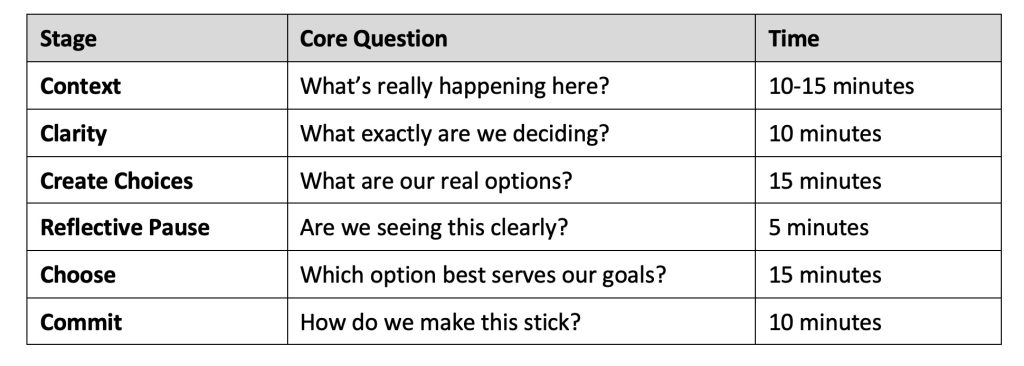
Total: 65-95 minutes for significant decisions
The 5C Quick Diagnostic
Before your next important decision, ask:
- Have we mapped the real constraints and stakeholders? (Context)
- Are we solving the right problem? (Clarity)
- Do we have at least three genuine options? (Create Choices)
- Are we evaluating against clear criteria? (Choose)
- Does everyone know who does what by when? (Commit)
If any answer is “No,” you’re not ready to decide.


 give teams a shared language and systematic discipline for decisions that hold up under pressure.)