

Recent Training Pulse surveys across the L&D Club community (480,000-plus members) reveal a clear direction for 2026. The headlines are unsurprising at first glance. The implications, however, are far more complex.
1. Agenda toppers: AI followed by leadership development
What are the top training and development focus areas in 2026 (283 votes)?
• Embedding AI in learning: 48%
• Leadership development: 29%
• Personalized learning: 16%
• Compliance training: 7%
AI is now firmly at the top of the learning and development (L&D) agenda. Nearly half of respondents are prioritizing embedding AI into learning ecosystems.
But this is not a story of replacement. Leadership development remains a strong second at 29%, suggesting something important: AI is not reducing the need for human capability; it is increasing the pressure on it.
The organizations moving fastest are not asking: “Should we use AI?”
They are asking: “Do our leaders know how to lead in an AI-enabled environment?”
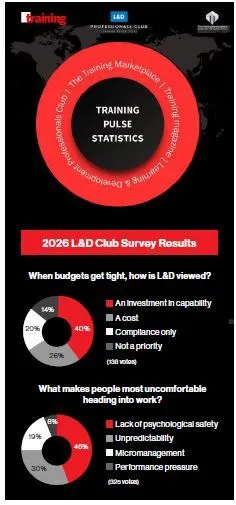
2. The budget reality: Investment versus perception
When budgets get tight, how is L&D viewed (138 votes)?
• An investment in capability: 40%
• A cost: 26%
• Compliance only: 20%
• Not a priority: 14%
There is progress here but not consistency. Some 40% of respondents now see L&D as an investment. That’s encouraging.
But 60% still sit somewhere between seeing learning and development as a cost, compliance, or a non-priority. This creates a structural tension: L&D is being asked to lead AI transformation while still justifying its existence in many organizations. This is the paradox of 2026. L&D is becoming more strategic in expectation than it is in perception. And that gap is where many functions will either elevate or struggle.
3. The cultural barrier: How employees feel
What makes people most uncomfortable heading into work (325 votes)?
• Lack of psychological safety: 45%
• Unpredictability: 30%
• Micromanagement: 19%
• Performance pressure: 6%
This is perhaps the most telling dataset of all. While organizations focus on AI, data, and capability frameworks, employees are signalling something more fundamental:
The biggest issue is how it feels to work there.
Psychological safety leads by a significant margin.
Not skills. Not tools. Not performance. Culture.
This raises a critical question for L&D: Can you successfully embed AI, transformation, or capability development in environments where people don’t feel safe? The evidence suggests not.
THE UNCOMFORTABLE TRUTH
There is a temptation to look at these results and conclude that 2026 is the year of AI in L&D.
That would be a mistake. AI is the headline. Culture is the story. Because when you step back and look at the data more closely, something else stands out. The question on psychological safety didn’t just produce the strongest signal. It produced the largest response.
• AI and future focus: 283 votes
• Budget perception: 138 votes
• Workplace discomfort: 325 votes
That matters. It suggests that while organizations are talking about AI and capability, employees are feeling something else entirely. They are engaging more when the question becomes real. Personal. Immediate.
Not: “What are your priorities for 2026?”
But: “How does it feel to walk into work tomorrow?” And the answer is clear. Nearly half are pointing to a lack of psychological safety. That is not a learning gap. That is not a technology gap. That is a leadership and cultural failure.
L&D is being asked to lead AI adoption, transformation, and capability building, but you cannot embed AI into an organization that people don’t trust. You cannot drive transformation in an environment where people don’t feel safe to change. You cannot build capability where behavior is constrained by fear.
The most effective L&D leaders in 2026 will not start with AI. They will start with leadership behavior, trust, and psychological safety. Then they will layer AI on top of that foundation. Because, in the end, the question is not “Are we adopting AI?” It is “Are we building organizations that are capable of adapting?”
The data suggest that remains the bigger challenge.