


Organizations are pouring billions into artificial intelligence (AI), yet fewer than 1 percent consider themselves mature in their use of it. The biggest barrier isn’t technology. It’s leadership. To embrace true AI adoption, we need leaders who can harness their most valuable differentiator: their humanity.
Gallup’s 2024 research shows that 70 percent of team engagement is driven by the leader. That should stop every reader in their tracks. Because no matter how advanced AI becomes, people don’t engage with platforms…they engage with the people rolling them out.
A recent Harvard Business Review study highlights a stark disconnect: 76 percent of executives think employees are enthusiastic about AI, while only 31 percent of employees actually feel that way. That’s not a communication issue. It’s a leadership disconnect.
Most AI initiatives focus on systems and data, but AI maturity depends on leaders who can guide people through change, make sense of complexity, and build the confidence their teams need to move forward.
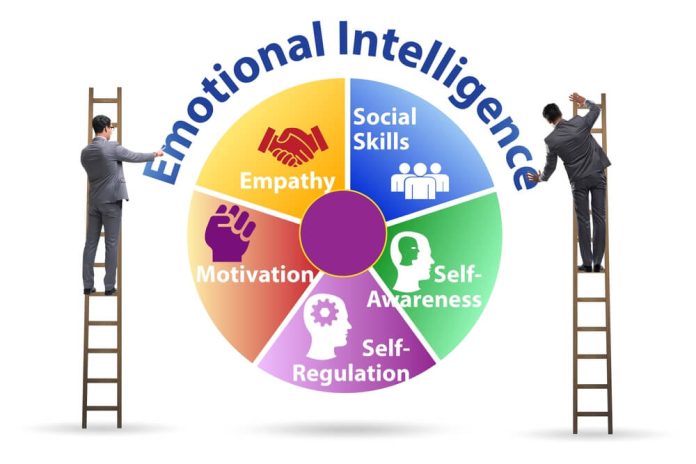
This is where emotional intelligence has become a non-negotiable. Leaders cannot guide teams through AI adoption if they don’t understand the emotional responses and anxieties the technology creates. Yes, AI brings speed and scale, but emotional intelligence is what brings trust, connection, and stability.
And although the temptation grows to let technology “smooth over” the difficult parts of leading through change, emotional intelligence isn’t something we can automate. It has to come from the leader. Teams don’t just need efficient messaging; they need to feel that the person guiding them genuinely understands their experience.
AI Can Simulate Empathy. Humans Make Meaning.
A story from my mentor brought this to life for me. She attended a briefing where her executives announced upcoming layoffs. Their messages were considerate, polished, and empathetic… on the surface. Something felt off. Their tone, rhythm, and even their phrasing sounded strangely uniform. Then she realized: They’d all used the same AI tool to refine their speech tracks.
The result? Fluency without authenticity. The words were technically “right” but emotionally hollow. And research confirms that when we sense that care is generated by AI rather than a human, trust declines. Many people also experience moral disgust if they suspect a message intended to connect emotionally is AI-generated. In critical moments, authenticity matters far more than perfectly crafted language.
AI Simulations: Powerful for Practice, Clear About Limits
This revelation is reshaping corporate learning priorities. Organizations are shifting investment toward developing emotional intelligence, relational capability, and human-centered leadership. That’s where AI simulations are becoming a bit of a game-changer. They give leaders a space to practice the human stuff—empathy, communicating with clarity, and reading the room—without the pressure of a real audience.
What makes these AI simulations so effective is how personal they feel. They adapt to each leader’s habits and stress points, almost like holding up a mirror that’s tuned specifically to you. And because there’s no judgment, leaders can experiment. They can try a different approach, rewind, and try again. It takes out the fear of “getting it wrong,” which is often the biggest barrier to showing up authentically with their teams.
Then, of course, there’s the feedback. This is where things click for people. Simulations give instant insight into tone, pacing, and decision patterns in a way real conversations can’t. In the moment, nobody stops mid-meeting to say, “By the way, your tone just shut me down,” but the simulation will. Those tiny awareness gaps leaders carry around for years suddenly become visible.
But we must remember that simulations have clear limits. AI can mimic empathy, but it cannot feel it. It can help coach behaviors but not replace relational authenticity. Without human coaching and peer support, the skills developed in low-risk simulations often stay there—they don’t make the jump into high-pressure conversations where leaders need them. Real behavioral change happens through practice, reflection, and accountability with another person.
The Power of Human Connection—The Enduring Advantage
This brings us back to the heart of the matter. Even with human and AI-powered tools to help leaders practice and prepare, the real differentiator will always be how leaders show up in real conversations. Our human connection is the enduring advantage.
That’s why empathy, active listening, and social influence remain among the most critical skills for the decade ahead. Leaders are the only ones who can create the conditions where trust and psychological safety take root.
This shows up in practical, everyday situations: noticing what someone is struggling to say, paying attention to changes in tone or posture, asking thoughtful questions, and responding with genuine care. These are the moments where teams decide whether to trust you and commit to change.
As AI takes on more cognitive load, the relational load becomes the true performance edge. The future won’t be won by the smartest systems but by the most human leaders. That’s the one advantage AI will never automate, replicate, or replace.