

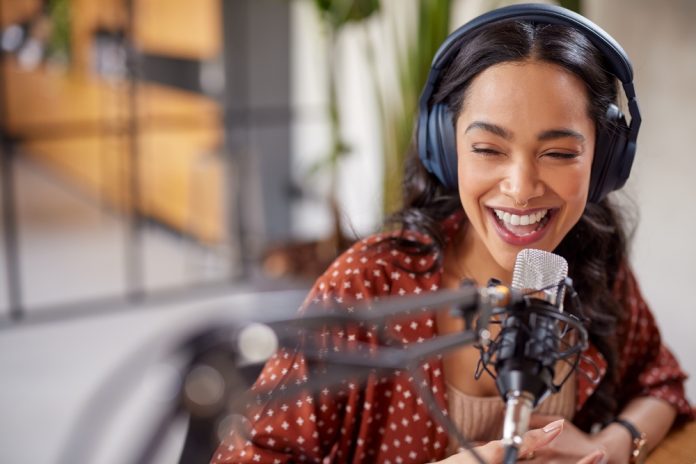
With hundreds of millions of podcast listeners worldwide—over 500 million monthly active users on Spotify and Apple Podcasts—it’s no surprise that podcasts are revolutionizing corporate training programs. These audio episodes are being integrated into L&D strategies in various ways and for clear reasons, from onboarding new hires to reinforcing executive communication skills.
This is Part 1 of a 2-part series. Here, we dive deep into the decision-making process: assessing if podcasts fit your goals, understanding why they outperform traditional formats, planning your content strategy with topic selection, formats, and guests, and making critical setup decisions for recording space and equipment.
Part 2 will walk through the full execution process from recording to analysis. This guide provides the framework for a successful launch.
The Strategic Decision: Do Podcasts Fit Your Training Goals?
Before committing time and resources, evaluate if podcasts align with your training objectives. Post-pandemic hybrid workforces demand flexible, on-demand content—podcasts deliver.
Podcasts excel because they’re scalable (no scheduling/Zoom fatigue), cost-effective (reusable during commutes/workouts), personalized (self-paced), thought leadership (authentic executive “fireside chats”), and measurable (downloads/completion rates).
Context matters: Hybrid teams? Multinational operations? Busy execs? Podcasts thrive here.
Proven for: Onboarding, upskilling, culture-building, microlearning (10-20 minutes), and continuous learning.
Research shows passive listening boosts retention 20-30 percent vs. spaced repetition—perfect for commuters, who make up about 32 percent of listeners (Literacy Trust, 2021). Workers already podcast daily; extending to L&D is natural. Podcasts have shifted from a “nice-to-have” to an expected L&D channel, rivaling webinars without the rigidity.
Key Decision Framework (score 1-5 per factor; proceed if 15+ total):
- Audience Fit (5 points max): Multitaskers = 5; Sedate on-site employees = 1 (Field sales/remote: Yes; desk-bound tech types who need visuals: lower score.)
- Content Suitability (5 points): Soft skills, stories, culture = 5; highly technical/procedural demos = 1 (videos are better for step-by-step compliance).
- Resource Commitment (5 points): 4-8 hours per episode biweekly feasible = 5; No time or ability to delegate executing or editing if solo = 1.
- Measurable Goals (5 points): You can track downloads/engagement = 5; you only track quiz scores = 1
- Organizational Buy-In (5 points): Leadership supports audio in LMS/Slack = 5; Little or no support = 1.
If podcasts match 3+ factors strongly, they’re a green light. If scores are low, pause and adjust—don’t force a podcast just because it’s trendy.
Podcasts vs. Traditional Formats Comparison
Podcasts differ fundamentally from webinars, eLearning videos, or static audio lectures in format, delivery, and learner experience—making them well-suited to busy corporate L&D.
| Podcasts vs Alternate Training Options | ||
| Aspect | Training Podcast | Other Recorded Training (Video/eLearning) |
| Format | Audio episodes, conversational | Visual slides/narration, structured modules |
| Length/Engagement | 15-25 minutes, bingeable series | 5-60 minute chunks, linear viewing |
| Production | Low-cost ($200 microphone + free or $12/month software), quick edits | High (camera/lighting, 4-8x edit time) |
| Accessibility | Multitask (drive/workout), low data | Full-screen focus, high bandwidth |
| Retention | Spaced replay boosts recall 20-30 percent | Visuals aid demos but drop off high without interaction |
| Metrics | Downloads, completion rates | View-time, quiz scores, compliance checks |
| Use Case | Reinforcement, culture, soft skills | Procedures, compliance visuals |
Content Planning: Topics, Formats, Hosts & Guests
Decision 1: Nail Your Topics. Transform classroom pain points into podcast gold:
Use your podcast episodes to solve specific problems, one small piece at a time. For your training staff, that may mean maintaining engagement throughout a webinar; for new employees, it may mean learning how to enroll in insurance benefits. For leaders, it may be how to deliver difficult feedback remotely. Some may be mini sound bites, and others may be longer.
Decision 2: Host/Guest Credibility. Credibility skyrockets when you can match the topic to someone who can bring a credible story to it—and who can deliver it well. The sweet spot: the intersection of audience cares-abouts, host framing clarity, and guest real-doings—yielding specific, example-rich 15-20 minute conversations with actionable takeaways from relatable pros or C-suite execs.
Decision 3: Format Alignment. Choose 2-3 based on goals/resources:
- Solo Monologues: Quick tips (“5 webinar hacks in 10 minutes”)—ideal for solo trainers building personal brand (lowest effort, full ownership).
- 1:1 Interviews: SME/peers on retention strategies—leverages guest networks for reach.
- Co-Hosted Discussions: Lively debates (two trainers on AI in eLearning)—chemistry divides prep.
- Panels/Roundtables: Diverse views (L&D leaders on hybrid training).
- Repurposed Hybrids: Zoom recaps edited with music/intros.
- Narrative Storytelling: Case studies (“Our onboarding flop and fix”) for microlearning (5-15 min).
Planning Template for Success:
Here’s a simple framework to organize your podcast episodes before recording, ensuring consistency and listener retention without overcomplicating prep.
- Cadence (Release Schedule): Biweekly 20-minute for upskilling/content-heavy training; daily 3-minute pep talks for motivation.
- Structure (Episode Blueprint): Outline (never full word-for-word scripts) = Hook (30 secs – state a problem), Body (3 stories or points, 15 minutes), CTA (30 secs – Clear next step: “Download template”). Results in a predictable flow = higher completion rates.
- Batch Ahead: Plan 10 episodes minimum for consistency before recording one. Write all outlines at once to ensure biweekly consistency for 5 months.
- Scale Smart (Tech Progression): Start phone + free Audacity; upgrade to Descript for AI edits ($12/mo) for AI magic (remove “ums”) after Episode 5. Don’t overspend at first.
Inspiration from Pros: Top Training Podcasts
There are educational and L&D-focused podcasts, such as David Rice’s People Managing People and Learning at Large, currently available (Rice, 2026).
Setup Decisions: Space and Equipment
Poor audio is the #1 killer: 50 percent abandon within seconds, and 20-35 percent abandon within the first 5 minutes. Trainers can’t afford mental tune-out.
Space Decisions (Budget: $0-50):
Where and when to record: Find a quiet space, such as a walk-in closet. Record in off-peak hours, if possible.
Prepare space to remove echo: Use inexpensive foam squares or moving blankets on reflective surfaces. Carpet on floors.
Prepare your room to reduce unwanted noise: shut off the HVAC, secure pets, ditch rustling clothes, block traffic—test ruthlessly. Listeners forgive content stumbles, but not beeps or distractions. There are tools you can download to measure “room noise” levels (extraneous sounds).
For guests: Create a Tip Sheet to help them do the above.
Equipment Decisions (Total < $400 Startup):
Microphone: Select the microphone best suited to your voice tone, your room’s acoustics, how much you move around during recording, and the number of audio features you want.
Headphones: Purchase closed-back (over-the-ear) style headphones (not earbuds) with no noise cancellation and no built-in audio enhancement.
Software: You will need software that can record, edit, and process your recording.
Here are three: Riverside, Audacity, and Descript.
Accessories: A microphone stand and pop filter ($35-50) to prevent plosives (breath pops) and vibration.
Bundles: Amazon and other electronics stores often bundle everything you need to start a podcast. Most are acceptable for beginners.
Ready for Part 2 execution? You’ve built the foundation for L&D podcast dominance. Check back for Part 2.
References
1. Literacy Trust. (2021). Young people’s engagement with podcasts in 2021.
2. David Rice, “14 Learning and Development Podcasts to Listen to in 2026,” January 30, 2026.