

We live in a time of unprecedented disruption. The pace and amount of change is relentless. Artificial intelligence (AI) is rapidly reshaping how work gets done, how decisions are made, and how value is created.
At the same time, work is far more collaborative, more creative, and more distributed than at any point in history. Many organizations are navigating hybrid or fully remote environments. Five generations are often working side by side, each with different expectations about success and meaning. Talent has more choice than ever before.
And yet, despite all this disruption, one thing has remained surprisingly the same: Our style of leadership simply has not kept pace with our changing world.
Much of modern leadership still operates out of a “Command & Control” mindset rooted in the industrial age. This approach emphasizes control, compliance, and predictability. While it may have produced results in a different era, the Command & Control approach is becoming increasingly irrelevant with the realities of today’s work and workplace. At best, it has evolved into a kinder, more enlightened version of itself. But at its core, it still prioritizes performance over people, with people treated primarily as a means to an end.
That approach has passed its expiration date.
The Life, and Power, Is in the Seed
More than a century ago, the hottest temperature ever recorded on Earth was measured in California’s Death Valley. Nothing grows there. Or so it seemed.
A few years ago, after an unusually heavy rainfall, the valley floor erupted into a stunning carpet of wildflowers. The seeds had always been there. They were not dead. They were dormant, waiting for the right conditions.
People are a lot like that.
Every person has potential inside them, often far more than they or their leaders realize. The role of leadership is not to manufacture motivation or force compliance. It is to create the conditions in which people can flourish. Great leaders act less like mechanics and more like gardeners. They recognize that the life and the power are already in the seed (the people).
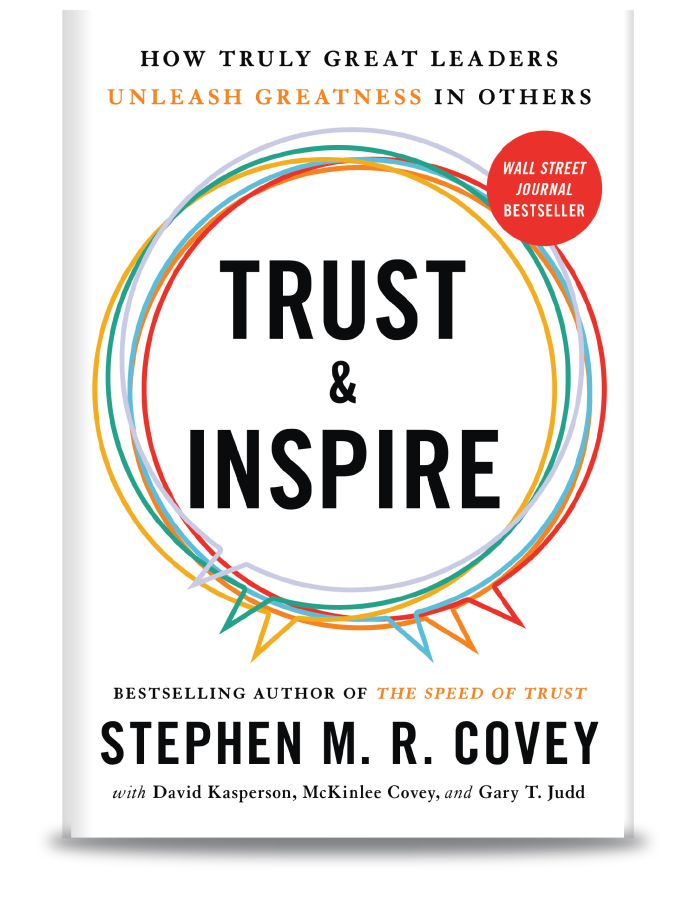
This is the essence of what I call “Trust & Inspire” leadership.
A World that Changed Faster than Leadership Did
Management thinker Gary Hamel once observed that most of the tools and practices of modern management were invented by people born in the 19th century. If a CEO from the 1960s were transported into today’s organization, much of what they would see would feel familiar.
That should give us pause.
The nature of work has changed, but leadership has lagged. Today’s organizations require collaboration, innovation, and judgment at every level. You cannot command creativity. You cannot control innovation. And you cannot coerce commitment.
This is especially true in an AI-enabled world. As technology takes over more routine and analytical tasks, the uniquely human dimensions of work become even more valuable. Connection. Judgment. Creativity. Caring. Empathy. Self-Awareness. Purpose. Meaning. These cannot be automated. They must be inspired.
Trust & Inspire leadership is not weak or soft. In fact, it consistently produces stronger results. It is authoritative without being authoritarian. Decisive without being autocratic. Strong without being forceful. It elevates people and performance together.
This is not a difference of degree. It is a difference in kind.
Two Epic Imperatives Every Organization Faces
Every organization today faces two defining challenges.
The first is to build a high-trust culture that attracts, engages, retains, and inspires talent. This is about winning in the workplace.
The second is to collaborate and innovate fast enough to remain relevant in a changing, disruptive world. This is about winning in the marketplace.
Here’s the key: The sequence matters! You cannot sustain winning in the marketplace with customers, partners, and communities if you are losing in the workplace with your own people, on your own teams, in your own culture. Great leadership works from the inside out.
Command & Control leadership struggles on both fronts. People don’t want to be managed; people do want to be led. They want to be trusted. They want to be inspired. Yes, we need good management of things—strategies, processes, systems, structures, data, and technologies, including AI. But we also need great leadership of people.
Trust & Inspire leaders manage things and lead people.
Being Trustworthy Is Not Enough
In my decades of research on trust, I have learned something that surprises many leaders.
It is possible for two trustworthy people to work together and still have no trust between them.
Why? Because trustworthiness alone (earning trust) is necessary but insufficient. Trust also must be extended (giving trust).
Most leaders I work with are credible, ethical, and well-intentioned. The problem is less a lack of trustworthy people (although sometimes that’s the case). The problem is more often trustworthy people who do not extend enough trust to others for it to truly matter.
Extending trust—trusting— is a deliberate leadership choice. When done well, it produces three outcomes consistently supported by data:
First, people rise to the occasion and perform better.
Second, people grow and develop new capabilities.
Third, people return and reciprocate the trust, strengthening relationships and culture.
So, in addition to being trustworthy, we as leaders also need to be trusting. Trusting is a better way to lead.
Inspiration Is the New Competitive Advantage
For years, organizations have focused on engagement, and rightly so. Engagement matters. But there is a new frontier.
Inspiration.
Research from Bain & Company shows that inspired employees are significantly more productive than both satisfied and even engaged employees. Inspiration changes how people show up.
And here is the good news.
Inspiring others is not a personality trait reserved for the charismatic few. It is a learnable skill. Everyone can inspire.
Inspiration literally means to “breathe life into.” Leaders inspire by connecting with people and connecting to purpose. When people feel cared about, they are inspired. When they see meaning in their work, they are inspired. When they know their contribution matters, they are inspired.
In an AI-accelerated world, this ability to inspire is not a nice-to-have. It is the new competitive advantage.
Two Actions You Can Take Right Now
If Trust & Inspire leadership sounds compelling but abstract, here are two practical steps you can take immediately.
- Extend trust deliberately.
Identify one capable person you may be under-trusting. Clarify expectations around outcomes and guidelines, mutually create a process for accountability, and then step back. Let them own the work. Observe not just the results but how responsibility changes their engagement and growth.
- Connect work to purpose, meaning and contribution.
In your next one-on-one or team meeting, ask a simple question: “Who does this work help and how?” Helping people see the impact and contribution of what they do is one of the fastest ways to inspire.
The Leadership Moment We Are in
Wherever there is sustained success, you will find leaders who model, trust and inspire. People are not commanded to greatness. They are inspired to it.
As technology accelerates and AI reshapes work, the need for leaders who can build trust and inspire human potential has never been greater. The demands of our time call for a new leadership approach. One that recognizes human capability, extends trust intentionally, and unleashes contribution at every level.
That is the leadership shift we will explore more deeply in my upcoming webinar February 26 at 3 p.m. Eastern with Training Magazine Network.
If you want to learn how to move from Command & Control to Trust & Inspire, how to extend trust without losing accountability, and how to build a culture where people do their best work because they want to, not because they have to, I invite you to join us. Please register at: https://www.trainingmagnetwork.com/events/4349?gref=tmagLL
This is not just a better way to lead.
It is a better way to live.



.)