


History is made. Four astronauts strap into the Orion spacecraft and travel farther from Earth than anyone has ever been. A 10-day, half-million-mile journey that captivates the world.
But those four astronauts aren’t doing it alone.
“Human spaceflight is the ultimate team sport,” NASA says. Behind the crew are thousands of engineers, scientists, and support staff working across continents. And every single one of them knows exactly where they’re going and why. It’s right there in the mission tagline: Moonbound | For All Humanity.
The Where. The Why. Simple enough to fit on a poster. Clear enough that everyone, from flight directors to facilities staff, can see themselves in it.
Here’s the thing: You don’t need a rocket to use the same approach. The principles that align a team to reach the moon can align your team to reach your most ambitious goal.
The Power of Dual Motivation: Head and Heart
Most teams fail to align not because they lack ambition, but because they speak only to the rational mind while ignoring what drives human behavior: emotion.
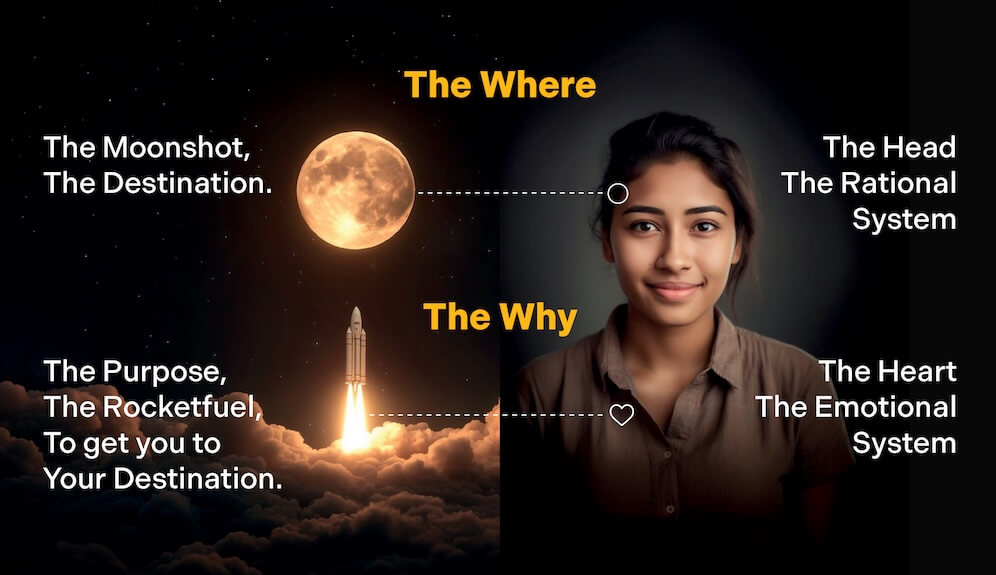
NASA doesn’t just give their teams a target. They give them meaning. Moonbound | For All Humanity works because it engages both systems:
- The Where (Your Moonshot): Like the moon in the night sky, this is your clear, visible destination. The thing that engages the rational mind. It provides a measurable target, logical stepping stones, and concrete progress tracking. It’s what “The Head” craves: Where exactly are we going?
- The Why (Your Purpose): This is your rocket fuel. The emotional power that propels you toward your destination. It taps into passion, meaning, and the reason anyone should care. It’s what “The Heart” needs to sustain effort through challenges: Why does this matter?
Without rocket fuel (Purpose), even the clearest Moonshot remains unreachable. Without a destination (Moonshot), all that passion burns without direction. You need both for liftoff.
The Where: Your Moonshot
There is an art to formulating the perfect Moonshot. In just a few words, it should excite your team with crystal-clear ambition while avoiding the trap of either comfortable incrementalism or impossible fantasy.
Use the S.T.A.R.S. Framework to Create the Perfect Moonshot
An effective Moonshot goal must meet five essential criteria:
S – Stretch: A Moonshot should be a stretch goal. One that is 80 percent impossible and 20 percent possible. It should push your team beyond their comfort zone. This is the “holy crap” test. If it feels comfortable, it’s not ambitious enough.
T – Tangible: Your Moonshot must be measurable, specific and timebound. Not “someday” but “by when.”
A – Aspirational: A Moonshot should be inspiring and exciting for your team. It should tap into their passions and motivate them to go above and beyond.
R – Relevant: Your Moonshot must be credible and aligned with your organization’s capabilities (that’s the 20 percent possible part). While it should be ambitious, it also must be grounded in reality.
S – Singular: A Moonshot should be a singular, unifying goal. Having other competing goals can dilute focus, confuse team members, and hinder progress.
Note: A Moonshot should never be financial. Goals such as “doubling revenue” don’t excite and engage teams the way a compelling destination does.
The Why: Your Rocket Fuel
Choosing your destination is only half the equation. Artemis II doesn’t just go to the Moon. It goes “For All Humanity.” That deeper motivation is what carries a team through the technical challenges that otherwise could overwhelm a mission.
Imagine a rocket without fuel. No matter how ambitious its destination, it’s not going anywhere. Your Purpose, your Why, is that rocket fuel. It’s the emotional energy that will drive your team toward your Moonshot.
Use the E.T.H.O.S. Framework for a Compelling Purpose
All Purpose statements should meet these criteria:
E – Eternal: Your Purpose should be the timeless reason for existence. It’s something you are passionate about and will always do.
T – True: Authenticity is everything. Your Purpose must genuinely reflect your organization’s core beliefs and values. A false Purpose is worse than no Purpose at all. It breeds cynicism and erodes trust.
H – Heartfelt: Purpose is fundamentally about passion and emotional connection. It should stir something in your team members’ hearts.
O – Oneness (Unifying): A powerful Purpose serves as a unifying force. It creates alignment and fosters a sense of collective identity across all levels of your organisation.
S – Simple: Keep it simple. Your Purpose should contain no more than three concepts and be less than seven words long. It needs to be easy to understand, remember, and communicate.
We Go Together
There’s one more lesson from Artemis II that often gets overlooked: The best Moonshots aren’t handed down from leadership. They’re co-created.
According to McKinsey research, when team members contribute to the development of initiatives, they are 3.4 times more likely to succeed. When people have a voice in shaping the plan, they feel empowered and valued. They see themselves as active contributors to the organisation’s success, not just passengers along for the ride.
That’s what makes “We go together, for all humanity” so powerful. It’s not just about the destination. It’s about the shared journey.
The Moonshot Test
As you follow the Artemis II mission, try this: Ask your team two questions: “Where are we going?” and “Why are we going there?”
If they struggle, or everyone gives different answers, you haven’t found your Moonshot yet.
A true Moonshot should create a “holy crap” moment. That palpable shift in the room when people realize the audacity of what you’re proposing. It’s 80 percent impossible, 20 percent possible. You should feel a mix of excitement and fear. If everyone nods comfortably, you’re not thinking big enough.
One Small Step
Thousands of people around the world are working on Artemis II. Each one knows where they’re going and why they’re going there. From engineers testing heat shields to the closeout crew, the last faces the astronauts see before launch, they’re all part of something bigger than themselves.
Where does your team ultimately want to go? And why are you going there?
Take one small step and chart a new course. Together.